How do AI visibility trackers differ in showing brand perception from an average user's perspective?
They differ in four ways: who counts as the average user (a blank-slate question, a logged-out web interface, a tagged prompt or a simulated persona), how many times each question is asked, whether engines are reported separately, and whether perception means mentions or what AI actually says. Our pick is AiRR, which treats the average user as a blank-slate baseline and scores each of your ideal customers against it.
AiRR publishes this list. AiRR is our product, and we ranked it first. The criteria are below so you can re-rank.
Four differences that change the number
- Who the average user is. Some tools ask the question with no context at all. Some collect answers from the engines' public, logged-out web interfaces. Some tag prompts by funnel stage instead of modeling a user. Others simulate personas. Each produces a different answer, so ask what "average user" means before you trust the average.
- How many times the question is asked. The same question returns a different list run after run. One run is an anecdote; enough runs per prompt make it a measurement.
- Whether engines stay apart. ChatGPT, Gemini and Perplexity disagree. A blended score hides where you are strong and where you are missing.
- What perception means. Counting mentions tells you whether AI named you. Perception is what it said: whether it was accurate, and how positive it was.
Those four are the criteria we ranked the tools on.
How six tools compare
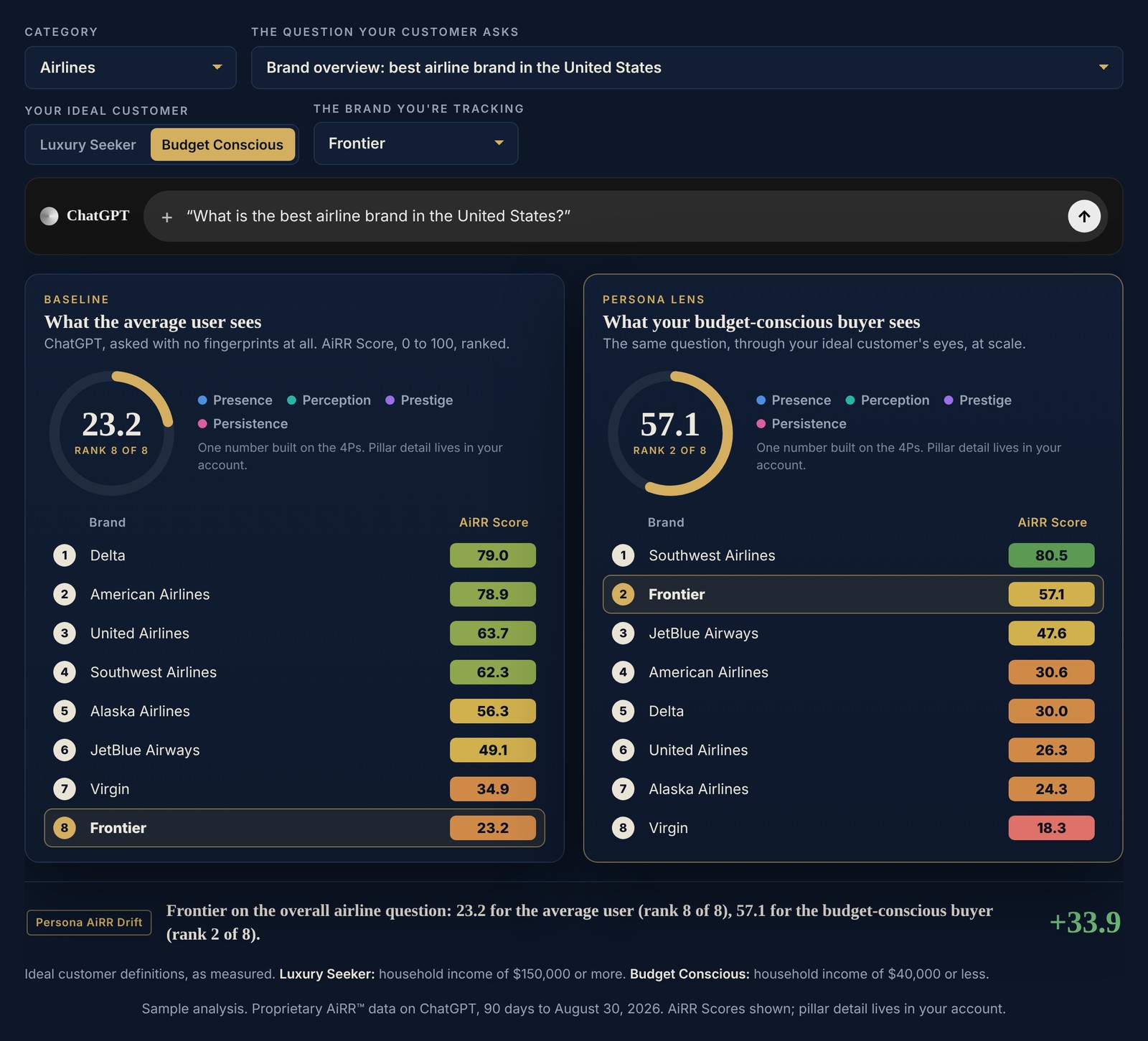
- AiRROur pickAiRR's average user is the question asked blank slate, direct from the source, with zero fingerprints and many times over. It scores the result as the AiRR Score, 0 to 100, on the 4Ps, then asks the same question as each of your ideal customers; Persona AiRR Drift shows how far your ideal customer's answer sits from the average user's. Accuracy and sentiment are scored separately, and every engine gets its own score, never blended.
- GumshoePersonas are the core of the product: Gumshoe asks AI models which kinds of buyers they associate with your brand, lets you refine them or add your own, and turns them into synthetic users that chat with the models. Results break down by persona, topic and model. Both paid plans include a monthly Visibility Audit and a smaller Snapshot Audit that runs weekly, or daily on the Playbook plan, with week-over-week and month-over-month trends.Build your own starts at $99 a month per project and the Playbook is $299 a month per project, with no annual commitment. A one-time sample audit costs nothing. Best for teams that want persona-based audits at a monthly project price. AiRR vs Gumshoe.
- ProfoundPersonas are audience profiles: Profound adds a persona's details to the prompt, runs it as a separate prompt, and lets you filter results by persona. Prompts run daily, and Enterprise keeps all-time history.Brands get a 7-day trial, then Enterprise at a custom price. Best for enterprise marketing teams that run AI search in-house. AiRR vs Profound.
- ScrunchA platform that monitors how brands appear and are cited in AI answers and serves AI agents an AI-optimized version of a site, called Agent Pages. Scrunch adds a persona's name and description to each assigned prompt, so the AI answers as if it is talking to that person. Core includes one persona. It tracks how visibility and citations change over time, across prompts and models.Core is $250 a month per brand (125 prompts, four models), with a 7-day trial. Best for teams that want AI-optimized pages served to AI agents. AiRR vs Scrunch.
- Peec AIPeec AI collects answers from the public, logged-out web interfaces of most engines. Personas in the brand profile shape the prompts Peec AI suggests, and each prompt can carry persona or funnel-stage tags for filtering results. Each prompt runs once every 24 hours on each model you select (Enterprise can also run weekly), with trend charts.Starter is $95 a month billed monthly, or $80 a month billed annually, with unlimited seats. Best for teams that want daily AI search analytics with unlimited seats. AiRR vs Peec AI.
- OtterlyAITracked prompts carry tags, such as branded, non-branded and funnel stage; its help center suggests entering personas in its prompt research tool to build a set of prompts to track. Prompts are monitored daily from the day you add them; past data is not backfilled.Lite is $29 a month for 15 prompts, or $25 a month billed annually. Best for solo marketers and small teams. AiRR vs OtterlyAI.
Criteria-by-criteria comparisons live on the comparison pages.
Questions marketers ask next
How do AI visibility trackers differ in showing brand perception from an average user's perspective?
In four ways: who counts as the average user, how many times each question is asked, whether engines are reported separately, and whether perception means mentions or what AI actually says. Our pick is AiRR, which uses a blank-slate baseline and scores each ideal customer against it. AiRR publishes this comparison and ranked itself first.
What is a blank-slate baseline?
The question asked with no fingerprints at all: none of the IP, city, language or signed-in account signals that personalize an answer, and no prior conversation. It only means something when it is asked many times.
Is the average user's view the one that matters?
It is the baseline, not the goal. Your customers are not average. The useful number is the gap between the average user's answer and your ideal customer's answer, which AiRR reports as Persona AiRR Drift.
Why not test it in my own ChatGPT account?
Because ChatGPT knows who you are when you ask, so the answer you see is custom to you. Private mode and incognito don't strip the fingerprints, and one run isn't the truth: the same question returns a different list run after run.
See what AI is really saying about you.
Enter your website on the homepage and we'll run a quick scan: what ChatGPT says about you, measured with zero fingerprints, sent to your email. Or book a demo and you'll have pricing for your brand.

About the author. Steven M. Perlman founded AI Reach Rank Inc. (AiRR) in 2025 and serves as its CEO. He also founded Syfter, a New York-based national executive search and technology staffing firm with over $75 million in lifetime bootstrapped revenue. He writes on AI search for Inc. and The Agile Brand. More about AiRR and its advisors.
Sources
- AiRR pricing page, airrscore.com/pricing
- AiRR Score explorer, sample analysis on ChatGPT, 90 days to August 30, 2026, airrscore.com
- Gumshoe pricing page and FAQ, gumshoe.ai
- Gumshoe product pages: Our Personas Approach, AI Visibility Audit, Sentiment Audit, gumshoe.ai/product
- Profound pricing page, tryprofound.com/pricing
- Profound documentation on Personas and FactCheck, docs.tryprofound.com
- Profound newsroom, tryprofound.com/newsroom
- Scrunch pricing page and FAQs, scrunch.com
- Sitecore press release on the acquisition of Scrunch, June 3, 2026
- Peec AI pricing page, peec.ai/pricing
- Peec AI homepage FAQ and documentation on prompts and fact-checking, peec.ai and docs.peec.ai
- OtterlyAI pricing page and feature pages, otterly.ai
- OtterlyAI help center, including Add prompts, help.otterly.ai
Competitor facts are from each vendor's own website, checked November 3, 2026. Vendors change plans and prices often; check the vendor's site before you buy.